About Us
Lorem ipsum dolor sit amet, consectetur elit, sed do eiusmod tempor incididunt ut labore et magna aliqua.
Lorem ipsum dolor sit amet, consectetur elit, sed do eiusmod tempor incididunt ut labore et magna aliqua.
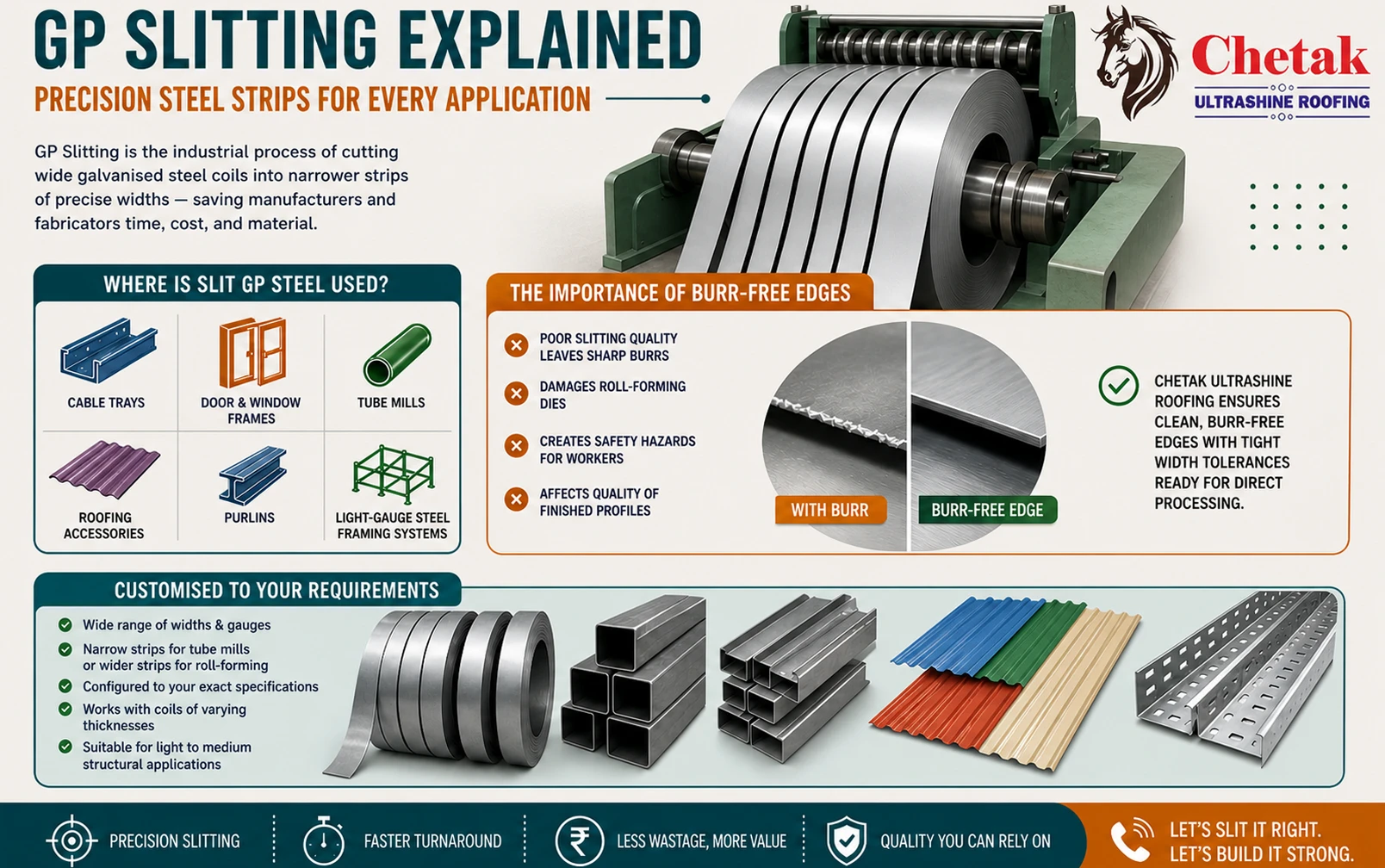
Not every project requires full-width steel coils or standard sheets. Many manufacturing and fabrication processes demand material in precise widths to ensure efficiency, accuracy, and minimal waste. This is where GP slitting becomes essential.
GP slitting is the industrial process of cutting wide galvanised steel coils into narrower strips with exact width specifications. It allows businesses to receive ready-to-use material, eliminating additional processing steps and improving overall productivity.
GP slitting involves feeding a wide galvanised coil through a slitting line equipped with circular blades. These blades cut the coil into multiple narrower strips simultaneously, based on required dimensions. The slit strips are then recoiled for easy handling, storage, and transportation.
This process ensures high precision, consistent width, and smooth edges — all critical for downstream manufacturing applications. It is widely used in industries where dimensional accuracy plays a key role in product quality.
Slit GP strips are used across a wide range of industries and applications. They are commonly found in cable tray systems, door and window frame manufacturing, tube mills, roofing accessories, purlins, and light-gauge steel framing systems.
By receiving steel in the exact required width, manufacturers can directly feed the material into their production lines without additional cutting. This not only speeds up operations but also significantly reduces material wastage and labor costs.
One of the most critical aspects of GP slitting is edge quality. Poor slitting processes often leave sharp burrs along the edges of the strip, which can cause multiple issues in downstream applications.
Burrs can damage roll-forming dies, increase wear and tear on machinery, and create safety hazards for workers handling the material. They can also affect the finish and accuracy of the final product.
High-quality slitting ensures clean, burr-free edges that are safe to handle and ready for immediate processing. Maintaining tight tolerances and consistent edge quality is essential for achieving reliable performance in fabrication and manufacturing.
Every project has unique specifications, and GP slitting services are designed to accommodate this variability. Manufacturers can choose from a wide range of strip widths and thicknesses depending on their application.
Whether you need narrow strips for tube mills or wider strips for roll-forming profiles, customised slitting ensures that the material matches your exact production requirements. This flexibility makes GP slit coils suitable for both light and medium structural applications.
Additionally, working with a reliable supplier ensures consistency in quality, timely delivery, and adherence to technical specifications, which are critical for uninterrupted operations.
Using slit GP steel directly from the supplier eliminates the need for in-house cutting, reducing operational complexity. It also minimizes scrap generation, leading to better material utilization and cost savings.
By streamlining the supply chain and reducing processing time, GP slitting helps manufacturers focus on their core production activities while improving overall efficiency.
GP slitting is a vital process for industries that require precision steel strips for efficient manufacturing. By delivering material in exact widths with clean, burr-free edges, it enhances productivity, reduces waste, and improves product quality.